Section 07
Hinterland & Logistics
Rail and road connections, intermodal terminals, hinterland markets.
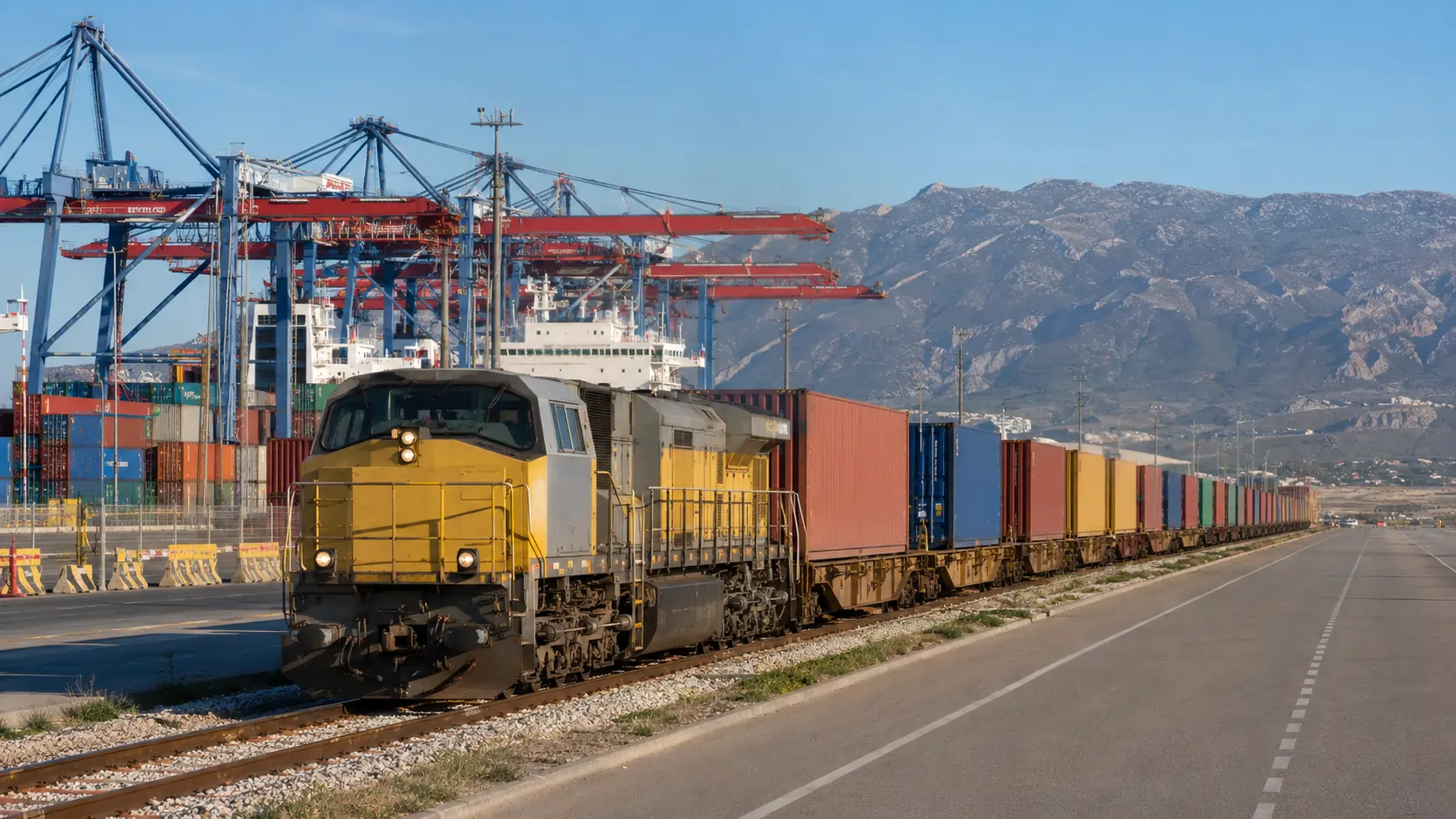
A port's commercial value is determined not only by what enters and leaves it by sea, but by the connections through which cargo subsequently reaches inland markets. The Port of Algeciras hinterland extends, at first instance, across the Iberian Peninsula, and, through intermodal connections, deep into central and northern Europe. The road and rail systems that connect Algeciras to its hinterland — and the inland customs facilities and distribution platforms that operate as extensions of the port — together constitute the logistics framework on which the port's commercial position rests.
Road network
The principal road artery serving the Port of Algeciras is the Autovía A-7 (the Mediterranean motorway) and its connection to the Autovía A-381 northward to Jerez de la Frontera and the broader Andalusian motorway network. From Algeciras, road transport reaches the Madrid metropolitan area in approximately seven hours, Barcelona in twelve hours, and the French border (La Jonquera or Irún) in fourteen to seventeen hours depending on routing.
Container road transport from Algeciras to the principal Spanish distribution centres operates under standard EU-regulated working hours and rest periods. The road industry serving the port comprises both nationally-licensed Spanish hauliers and an extensive presence of Moroccan-licensed hauliers serving the cross-Strait corridor. Trailer movements between Algeciras and the Spanish-French border area dominate the long-distance flow, with shorter-haul flows serving Andalusia and the southwestern peninsula.
Rail connections
Rail freight from Algeciras is served by the Bobadilla–Algeciras line, a conventional gauge (Iberian, 1,668 mm) single-track railway that runs northward through the Ronda mountain corridor to connect with the principal Spanish rail freight network at Bobadilla. From Bobadilla, container train services proceed to Madrid (Coslada and Vicálvaro inland terminals), to Zaragoza (via the Madrid–Zaragoza corridor), and to the Mediterranean corridor toward Barcelona and the French border at Portbou.
The Bobadilla–Algeciras line is, at the time of publication, electrified for the section nearest to Algeciras and operates with a mix of locomotive types. Container block trains depart APM Terminals Algeciras and the inland rail yard at La Línea on regular daily schedules. Train length and axle load limitations on the route restrict the maximum payload of individual block trains relative to mainline European freight corridors, but ongoing investment in the line during the 2010s aimed to bring its capacity closer to European mainline standards.
Iberian gauge, in context
The Spanish and Portuguese national rail networks were historically constructed to a broader track gauge (1,668 mm) than the standard European gauge (1,435 mm). This dimension difference imposes practical constraints on direct rail freight between the Iberian Peninsula and the rest of Europe; cargo is either transhipped at the French border or carried on variable-gauge rolling stock that can adjust between the two gauges. New high-speed and dedicated freight lines in Spain have, since the early 2000s, been constructed to standard European gauge to facilitate trans-European operation.
Inland customs and logistics platforms
The Spanish customs administration permits the conduct of customs formalities at designated inland sites rather than exclusively at the port of entry. For containers arriving at Algeciras, customs clearance may take place at the port itself or at one of several inland customs platforms — principally the Centro de Transportes de Coslada (Madrid), the Plataforma Logística de Zaragoza (PLAZA), and platforms in Barcelona and Valencia. This arrangement permits a portion of the customs administrative burden to be distributed away from the port itself, supporting overall throughput velocity.
Hinterland markets
The natural Port of Algeciras hinterland, defined as the geographic market for which Algeciras is the most competitive port of entry, comprises:
- Southern Spain — Andalusia, Extremadura, and the southern half of Castile-La Mancha. For these regions Algeciras competes principally with the smaller Andalusian ports (Cádiz, Málaga, Seville) and offers the dominant share of containerised import volume.
- Central Spain — Madrid metropolitan area and surrounding regions. For Madrid, Algeciras competes principally with Valencia and Barcelona; the choice of port reflects shipping line routing, transit time preferences, and inland transport cost considerations.
- Portuguese market — particularly the southern and central Portuguese demand centres. Algeciras competes with the Portuguese ports of Sines, Lisbon, and Leixões for these volumes.
- North African feeder market — Morocco, Algeria, Tunisia, and the Mediterranean Libyan coast. For this market Algeciras operates principally as a transshipment origin rather than as a direct gateway, with feeder vessels distributing containers to the destination ports.
- West African feeder market — Atlantic-coast Africa from Casablanca southward. Algeciras serves this market principally through feeder services connecting to West African ports.
Free zones and bonded facilities
The Port of Algeciras hosts a designated Free Trade Zone — the Zona Franca de Cádiz, Algeciras delegation — offering customs-suspended status for goods entered for warehousing, manipulation, or re-export. The Free Zone is principally used for goods awaiting onward distribution to North African markets, where the customs-suspended status permits flexible commercial arrangements without the immediate fiscal burden of Spanish or EU customs entry.
Bonded warehouse facilities of a more conventional character — for goods held under customs control pending entry or re-export — operate within and adjacent to the port. The combination of Free Zone status and bonded warehousing supports a logistics economy that, while modest compared to the Free Zone economies of certain Asian transshipment hubs, contributes to the commercial flexibility of the port.